Mbeles
The Color PurpleThe Mbeles are a forest-dwelling community that offers refuge from colonial rule and plantation labor, and an alternative to the dispossession of the Olinka people. For much of the story their existence is uncertain, known through rumor; when Adam reaches their encampment and returns with Tashi, the reported refuge becomes a place with a community and institutions, as well as a base for resistance.
Identity and Reported Purpose
The Mbeles are described as people living deep in the forest who welcome runaways and resist white control. The reports reaching Nettie and Samuel say that they harass white plantations and plan for the colonizers’ removal from the continent. Samuel considers joining them and encouraging the Olinka people to do the same, but Nettie objects that some Olinka are too old or sick to move into the forest, women have young babies, and others want goods such as bicycles, British clothes, mirrors, and cooking pots. The exchange presents the Mbeles as a possible form of organized refusal, while making clear that flight and resistance are not easy or universally available choices.
The family does not initially know whether the Mbeles truly exist. Tashi and her mother leave to join them, and Adam and Olivia are heartbroken: they miss Tashi and believe that no one who has gone to the Mbeles has ever returned. This uncertainty matters. The group first appears in the narrative as a possibility spoken of by others, beyond the reach of the missionaries’ knowledge and protection, rather than as a community the letters can describe firsthand.
The Forest Refuge and Its Organization
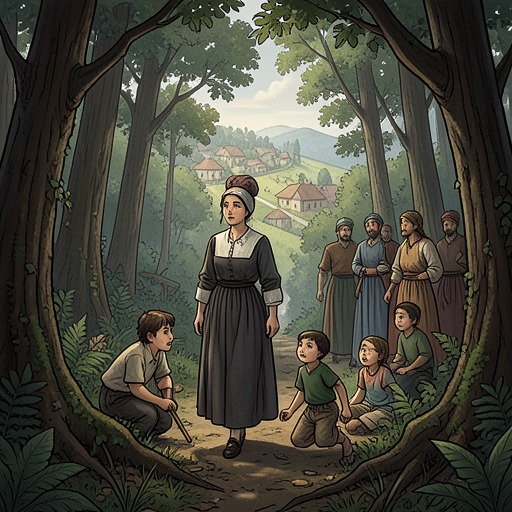
Adam eventually overtakes Tashi, Catherine, and other members of the compound as they approach the village where the white woman missionary had lived. Tashi and Catherine refuse to turn back, and Adam accompanies them to the Mbeles encampment. After two and a half months, Adam and Tashi return. His account places the refuge in a deep, canyon-like rift on the same side of Africa as the Olinka settlement. He describes a population of about a thousand people drawn from dozens of African tribes, as well as one Black man from Alabama.
The encampment is not only a place of concealment. Adam reports farms, a school, an infirmary, and a temple, alongside male and female warriors who undertake sabotage missions against white plantations. These details give the Mbeles a social and practical infrastructure: food is grown, learning and care have places within the settlement, and armed resistance is part of its activity. The evidence comes through Adam’s account, relayed by Nettie; it establishes what he says he encountered without turning the community into a fully observed or exhaustively described society.
Colonial Dispossession and the Turn to Resistance
The Mbeles become significant against the destruction of Olinka Village. The roadbuilders, initially treated by the Olinka as a route to the coast, continue their road through the village under armed orders. Homes, crops, the church, the school, and the missionaries’ hut are destroyed. The chief later learns that the territory, including the village, belongs to an English rubber manufacturer; forest is cleared for plantations, while the community’s land and water are taken for colonial development.
The Olinka are then forced from their village to a barren site without water for six months of the year. The plantation takes the land’s roofleaf, which the Olinka regard as sacred, and the destruction of their yam crops contributes to illness as the people lose food that had helped protect them against malaria and chronic blood disease. As these pressures intensify, some of those close to Nettie and Samuel flee to the Mbeles rather than work for white planters or submit to white rule. The forest refuge is thus linked to more than political dissent: it becomes a destination for people pushed from home, livelihood, and cultural practices by the plantation system.
Adam, Tashi, and the Limits of Return
The departure of Tashi and Catherine gives the Mbeles personal meaning within the Olinka household. Adam follows them despite the family’s uncertainty about the group and despite the belief that those who join it never return. His journey makes the feared separation partly reversible: two and a half months later, he and Tashi come back to the compound. Their return does not establish that Catherine or the other travelers returned with them. Nor does it erase the danger and distance associated with the Mbeles; Adam has gone to the encampment and come back, while Tashi’s initial refusal to turn back shows that joining was not a brief or easily abandoned choice.
Nettie observes that Adam and Tashi seem absorbed in each other, even as Adam recounts the remarkable settlement. They arrive filthy, exhausted, and still arguing. The scene brings the remote resistance community back into the intimate life of the compound without reducing it to a backdrop for their relationship. In the narrative, the Mbeles remain both a concrete refuge—with farms, institutions, and warriors—and a challenge to the colonial order that has made the Olinka’s own home unlivable.